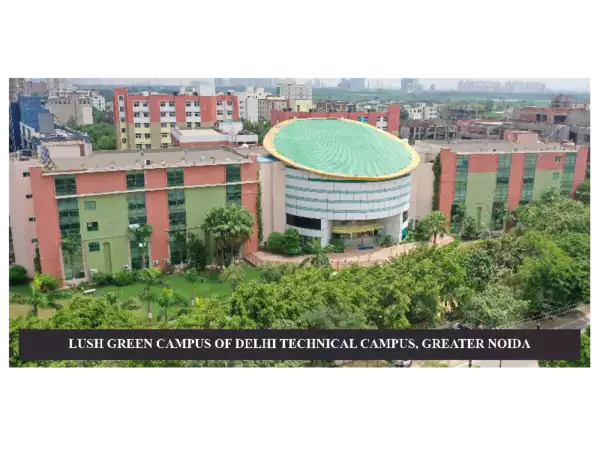
DTC Greater Noida Value Added Courses Targeted the Skills Gap
Delhi Technical Campus expanded its academic offering in 2023 with short skill-based programmes intended to sit beside regular degree courses and expose students to tools used in technology and business. DTC Greater Noida value added courses covered areas such as web development, artificial intelligence, SAP, AutoCAD and productivity software, while the institution also worked with cells connected with IITs and IIMs for some certification programmes.
The idea was to give students practical material that could change faster than a university degree syllabus, without replacing the core programme they were already studying.
The courses sat beside existing IP University degrees
DTC was affiliated with Guru Gobind Singh Indraprastha University and offered programmes including B.Tech in Computer Science Engineering, AI and Machine Learning, AI and Data Science, along with B.Arch, MBA, BBA and B.Com. The value-added courses were introduced as another layer around those formal qualifications rather than as substitutes for them.
This structure gave an engineering student a chance to work with a specific industry tool while still progressing through the broader mathematics, computing and engineering material required by the degree.
The subject list mixed technical and workplace skills
Technical options included SAP, artificial intelligence, machine learning, web development, Tally and AutoCAD, while the programme also covered Microsoft Office, soft skills and life skills. The range reflected a practical problem faced by colleges because employers may expect familiarity with tools that do not justify a complete degree subject of their own.
A short course can introduce such a tool quickly, although real competence still depends on how much time students spend applying it after the certification session ends.
External certification was part of the appeal
DTC promoted collaboration with recognised institutions as a way to give students exposure beyond the college’s normal timetable. Director General Justice Bhanwar Singh highlighted those partnerships, while Dean Academics Dr Pranay Tanwar connected relevant certifications with employment exposure and better preparation for recruitment.
A certificate can help an employer understand what training a student completed, but the stronger signal comes when the student can also show a project or solve a practical problem using the same skill.
Web development fits this model particularly well
Web development changes quickly enough that short practical courses can complement a longer computer science programme, especially when students already know basic programming and need experience connecting HTML, CSS, JavaScript and server-side tools in one project.
A small working application gives students somewhere to apply those separate concepts at once, making gaps visible much faster than another written explanation of each technology in isolation.
Employability was a central reason for the launch
DTC described the courses as a response to changing technology-industry demand, with the expectation that students would leave college with experience beyond the standard academic curriculum. Chairman Vipin Sahni argued at the launch that education had to anticipate future requirements instead of relying only on past practice.
That argument has a clear limit. No college can predict every tool an employer will use several years later, so the most useful short courses are those that connect a current technology with transferable habits such as debugging, communication and project work.
Degree admission rules remained separate
Admission to DTC’s main programmes continued through university counselling and the management quota under the applicable rules, with JEE used for engineering, NATA for architecture and CUET or CET applying to other courses described by the institution at the time.
The value-added programme changed what students could learn after entering DTC, while the formal route into the underlying degree remained a separate admissions process.